Nanomachine Constituent Scaling Laws
In the previous chapter, it was established that the search for performance gains will push toward incrementally reducing the number of molecules needed for the nanosystems described in chapter 2, until the "monomers" and building blocks become individual molecules and atoms.
This chapter expands on that view to derive the "Nanomachine Constituent Scaling Laws," a set of directions for technological development that, if pursued, yield greater performance.
There are three distinct phases through which this happens, and they can all be summarized as a shift toward less self-assembly and more deliberate bond formation, until the atomic ceiling is reached.
The three phases, along with the structural and chemical tools associated with each and the order in which they succeed one another, are as follows:
| Phase | Structural/mechanical components and tools | Chemical-scale engineering tools |
|---|---|---|
| Infant nanomachines | Nanoparticles | Aggregated behavior of molecules in chambers and on surfaces |
| Adolescent nanomachines | More precise nanoparticles, with some features approaching macromolecular dimensions | Both aggregated in-chamber/surface molecules and the first macromolecular tooltip devices for directed chemical transformations |
| Adult nanomachines (Machine Phase Chemistry) | Machine-phase matter making up all structural components, or parts made by machine-phase matter systems, with some dimensions in the single small-molecule regime | Molecular tooltips |
Firms and efforts looking to scale their systems will need to weigh the following factors.
Factors driving the infant-adolescent transition
- Waste reduction. The infant nanomachine paradigm represents the pinnacle of nanomechanics as currently conceived. But building these systems out of nanoparticles, macromolecules, and nanoglue inevitably produces some bill of waste. Additive manufacturing methods will be used to produce them, yet unwanted byproducts will still appear at some level. Progress on reducing discarded molecules and reagents will push systems toward fully utilizing raw materials, producing more nanomachines per kilogram of feedstock and energy. Volume alone will bootstrap improvements to devices once they're deployed at scale.
- Better chemistries. Better feedstocks, better binding nanoglue, better dopants, and so on.
- Search for more integral components. Phasing out reagents prone to shedding in favor of ones with greater structural integrity, which reduces the need for replacement and reinforcement and allows for larger components.
- Size-function reducibility. Initial nanomachines can be stripped down to their most irreducible parts. For example, an early version might use motor proteins such as kinesin-tubulin or actin-myosin as nanomotors. A later version might use only the motor domains of those proteins. And a later version still might use synthetic molecular motors closer in size to small molecules than to the large macromolecular proteins they replaced.
- Better heat management.
- Better production parts. Infant nanomachines build better infant machines, those build the toddler machines, and those eventually build the adolescent ones. This includes more precise nanoparticle geometries, more precise force transmission, faster and more stable plate transfer, and so on.
- Automation, to make labor-intensive quality control scalable.
- etc.
to do add more later, add references, add rigorous mathematical models and derivations
Factors driving the adolescent-adult transition
This transition happens as efforts push the limits of aggregated molecular behavior toward single small-molecule entities in chambers or on surfaces, until molecular tooltips become commonplace.
It is at this point that architectures begin to resemble mechanosynthetic, Drexler-style nanomachines.
The nanomachine scaling law curve
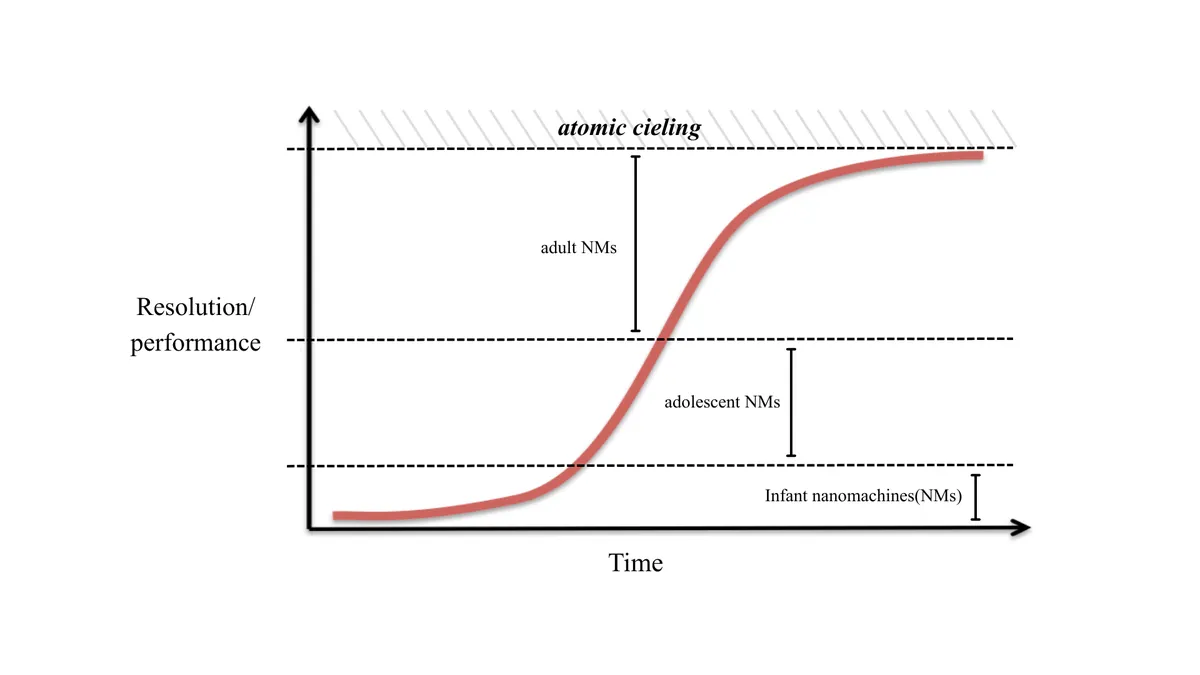
When you plot these on a curve, you get an s curve with three distinct scaling phases. The infant phase begins and lasts a relatively long time because it's new, there are lots of unknown unknowns, and people are generally comfortable with the performance gains they're getting from this class of previously impossible machines. However, as the factors mentioned above start to take hold, and as the infrastructure to make, simulate, prototype, manage, and improve these systems begins to mature, a steeper improvement curve appears. The rate of improvement compounds, and the first exponential betterment shows up at the infant-adolescent transition. This rate of improvement keeps increasing until the adult phase is reached. At that point, the rate of resolution and performance gains caps off as we approach the atomic resolution limit. Most of the improvement felt at this adult stage comes from work optimisation and volume maxxing.
The next frontier beyond that is gatekept by atomic physics itself. Engineering nuclei on the surface of neutron stars is out of scope for this volume, so we won't get into it here.