Intro to Cytronics
Definition
Cytronics is the engineering discipline concerned with the design, fabrication, and operation of controllable nanoscale devices for cellular engineering purposes.
It is distinct from nanoparticle medicine, which relies on the passive chemical behaviour of unguided particles that lack mechanisms for active logic, autonomous navigation, or real-time computational control.
Applications
- Sensing and Cell-computer interfaces
Establishing direct, bidirectional communication pathways between biological cells and external computing systems. A theoretical example is neural dust which are proposed nanoscale wireless sensor devices capable of recording neural activity from within tissue.
- Cell repair (Nanosurgery)
Using programmable nanoprobes to actively correct damaged organelles and molecular defects at the subcellular level. Scientists such as Robert Freitas have prosed devices such as the chromallocyte which is a theoretical nanorobot designed to perform chromosome replacement therapy by extracting a cell's full complement of chromosomes and inserting corrected copies, enabling repair of genetic damage, somatic mutations, or chromosomal abnormalities.
- Nanorobotic drug delivery
Self explanatory.
- Cell replacement
Deploying synthetic nanoscale devices to fully substitute for compromised, non-functioning, or destroyed cells. The canonical theoretical design is the respirocyte, proposed by Freitas in 1998 which serves the function of an artificial red blood cell.
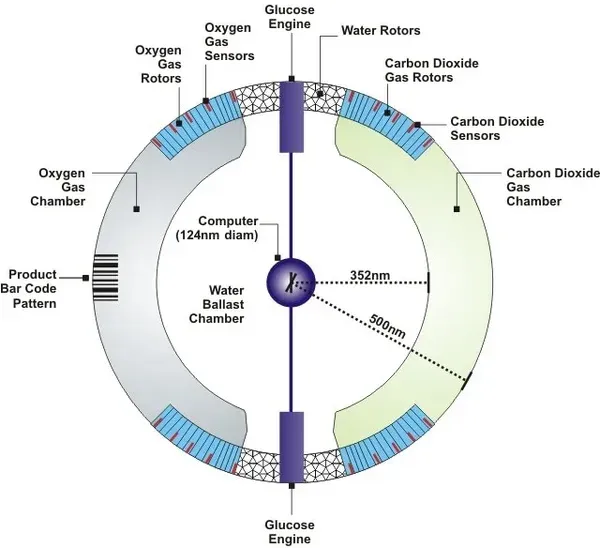
Proposed design for a respirocyte
Approaches to manufacturing cytotronic nanodevices
Because medical nanorobots have almost all their features operating mechanically in the nanometer regime, conventional fabrication methods are insufficient. Their construction would require positional assembly which the precise placement of individual atoms or molecules to build coherent three-dimensional heterogeneous structures.
No general-purpose positional assembly system has yet been demonstrated, but proof-of-concept work across several approaches shows that building ordered 3D nanoscale objects is physically achievable. These include structural DNA origami which folds DNA strands into arbitrary geometries with sub-nanometer precision, protein nanotechnology, which exploits the natural folding and self-assembly of engineered proteins, mechanosynthesis, which uses scanning probe tips to place reactive molecules with atomic precision, and additional methods under active development in academic and commercial laboratories.