Eric Drexler, Dry Nanosystems and Wet Ones
In 1992, Eric Drexler published Nanosystems, a rigorous technical treatment of how nanomachines built from molecules could be constructed and made to operate. Prior to that, he published Engines of Creation, which described an immensely compelling future that would be unlocked if we had nanotechnological means to process molecules for manufacturing and medicine.
The core of the systems he postulated was this: using sufficiently precise tools, you could place individual atoms, mostly carbon, into exact positions to form rigid nanoscale parts made of diamond. By connecting those parts to nanomotors, you could construct literal mechanical machines and force transmission systems out of bare molecules, not surfaces.
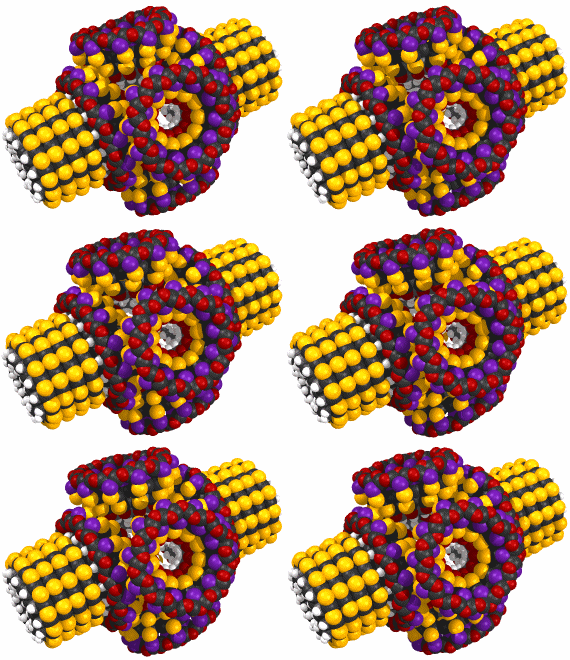
The chemistry underlying this was dubbed mechanosynthesis, an alternative to conventional chemical synthesis in which every bond is mechanically dictated by computer control.
As of 2026, the feasibility of mechanosynthesis has been demonstrated in principle, but the resultant nanomachines have not yet been realized. That gap is what propelled this author to explore whether nanomachines capturing a meaningful fraction of what Drexler postulated could be built using chemical methods far more experimentally accessible than the ultra-high vacuum, highly reactive, SPM tip-based radical chemistry his approach requires.
While many of the defining characteristics of Drexlerian machines would ideally be preserved(including nanometer-scale resolution and surface force minimization), the central departure here is the abandonment of angstrom-resolution machines and per-bond computer control. Instead, the building blocks chosen are ones with strong self-assembly tendencies, such that combining them in bulk and allowing them to equilibrate causes them to fold into the three-dimensional structures required.
The key reframe is that bulk synthesis is treated as an ally rather than an obstacle. And the most obvious source of inspiration for this approach is biology, which has capitalized on exactly these properties for billions of years.
This is the introduction to that space: wet nanosystems, not dry ones.